Wool Industry Introduction
The South African wool industry provides a high-quality, environmentally-sound product which meets the needs of the textile industry. South African wool is largely an export commodity, in both pro cessed or semi-processed form. It is produced and traded in a sophisticated free market business environment into the international marketplace, where supply and demand forces determine price levels.
Wool Production
Wool is produced in most parts of South Africa under either extensive, semi-extensive or intensive condi tions. The carrying capacity of the wool producing areas varies from 5 to 10 hectares per small stock unit in the more arid areas, to 25 small stock units per hectare on cultivated pastures.
The sheep breed with the highest wool production per head in South Africa is the pure-bred Merino, followed by other dual-purpose Merino strains, of which the Dohne Merino, the South African Mutton Merino and the Letelle are the most popular. The South African wool clip is predominantly a Merino clip but coarse and coloured types are also produced and marketed on a limited scale. More than 50% of the clip is produced in two provinces, namely the Eastern Cape and the Free State.
Capewools are traded either through the auction system or by private treaty. The largest percentage of the clip is sold through the auction system. Auctions have been centralised in Port Elizabeth and take place once a week during the season (August to June). Even though centrally auctioned (i e sale by separation), wools are warehoused in three of the four ports, viz Port Elizabeth, Cape Town and Durban.
Volumes
In 2006/2007 the total South African production figures totalled 46 822 912 kg (including Lesotho & Namibia), an increase of 2,1% on 2005/06 and generating sales to the value of R1 123,935-million . This figure was almost 66% higher than the R678,249-million recorded for the previous season. The Eastern Cape produced 14 145 639 kg and generated sales of R 368, 6 million. It is estimated that South Africa would produce between 300 000 – 320 000 bales of wool for 2007/2008 season. At 150 kg per bale, this equates to 46 000 to 48 000 tons.
Location
The areas in the Eastern Cape where the larger volumes of wool are produced includes Ciskei/Transkei, Barkley East, Cradock, Somerset East, Albert, Aberdeen and Graff Reinet.
Mohair Production
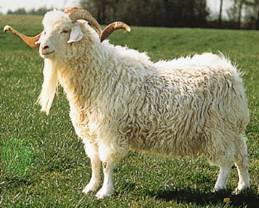
South
Africa, the world leader in mohair production,
represents an industry in which this noble fibre
constitutes less than one per cent of all global natural
fibres. The Angora goat originated in the Tibetan
mountains.
Volumes
Mohair South Africa today leads the global mohair market with a 58% share of world production. Some 850 000 goats producing 3.6-million kilograms of mohair generated R210-million in 2005, according to figures released by Mohair, and the Eastern Cape districts account for roughly 90% of South Africa's total production. All mohair produced in South Africa and Lesotho comes to Port Elizabeth for washing, combing, sorting, baling and auction. Mohair even gets sent here from Texas for processing and is re-exported. A total of 95% of SA production is exported in raw or semi-processed form to all destinations, including Europe, the UK and the Far East.
Transport
Road is the mode of transport that is being used locally, with less than 1% of rail that is being utilized. The inbound cargo is arranged by wool growers and their haulager agents from the production areas to Port Elizabeth. Large producers transport the bales themselves using their own trucks. Small scale mohair producers make use of contractor transport or the broker transports the bales to the auctions.
For outbound, the buyers arrange transport to scouring plants in Uitenhage or rail cargo to Port Elizabeth harbour for export. The vehicle utilised varies from rigids to articulated and draw-bar trailers.
For shipping purposes, high-density presses (dumps) are used at all three ports of discharge. These dumps allow for compressing bales into a third of their original size, making it possible to pack 96 bales into a 6 m container. The average bale mass is 150 kg and dumping is carried out on a pre-sale basis.
All greasy and semi-processed wool destined for the export market is containerised and Cape Town, Port Elizabeth and Durban are served by an efficient container shipping service to Europe, America and the Far East. Average on-board time to these destinations is 17 - 22 days, 30 days or 32 days, respectively.
Statistics
|