Waste Disposal Introduction One of the fundamental approaches in the The White Paper on Integrated Pollution and Waste Management policy is the prevention of pollution, minimisation of waste, control of impacts and remediation. The management of waste is intended to be implemented in a holistic and integrated manner which will extend over the entire waste cycle, from cradle to grave, and will include the generation, storage, collection, transportation, treatment as well as the final disposal of waste. Since the promulgation of section 20 of the ECA, a total number of 400 waste disposal site permits have been issued. This figure represents approximately 52% of the general domestic refuse sites in South Africa (and excludes the approximate 15 000 communal waste disposal sites in rural areas and the industrial sites). All the commercial hazardous waste disposal sites in South Africa are now being controlled via permits in terms of the above-mentioned legislation.
Total general waste from households, commerce, institutions, and the manufacturing industry was approximately 13.5–15 million tonnes per year in 1998, which increased over the last number of years due to rising population and economic growth. In addition, a further 22 million tonnes per year of industrial wastes are generated, handled, and disposed of in-house (on-site). Nationwide, about 8.8 million tonnes of domestic waste required collection and disposal in the financial year 2004/2005. During the six years from 2004 to 2010, domestic waste is predicted to rise by 1.1 million tonnes to some 10 million tonnes or more.
The majority of domestic residential and commercial, business and industrial waste from urban areas is disposed to landfill sites. These landfill sites are generally operated by the local authority in whose area the site is located, or by private service providers .
Nelson Mandela Metropole
In the Nelson Mandela Metropole the Municipality currently owns and operates its own general waste disposal site at Arlington, Port Elizabeth, and low hazardous and general waste disposal site at Koedoeskloof, Uitenhage. Both of these sites are fully compliant with all appropriate legislation. These sites have the capacity to fulfill the waste disposal requirements of the Municipality for approximately the next 50 years.
All generators of non-hazardous waste must bring their waste to one of the two municipal waste disposal sites.
The private sector operates a high hazardous and general waste disposal site at Aloes II , situated on the old Grahamstown Road. This is one of only three high hazardous waste disposal sites in the entire country. Garden refuse is collected via transfer stations and skip sites throughout the Municipality, which also receive other types of waste from domestic consumers. See the map for locations of the existing transfer stations and skip sites.
Click here to view the Map of Landfill Transfer and Skip Sites Operation NMM waste disposal sites
Situated near the Arlington Race Course, alongside Victoria Drive, off the Schoenmakerskop Road, Port Elizabeth Tel: +27 (0) 41 366 1052
Operating
hours:
Closed on Christmas and New Year’s Day.
Accept all types of general waste.
KOEDOESKLOOF WASTE
DISPOSAL SITE
Operating hours: Monday – Friday (07:00 – 17:00) Saturday (07:30 – 17:00) Sunday (09:00 – 17:00) Closed on Christmas and New Year’s Day.
Accepts hazardous and general waste
Developments to NMM waste management strategy
With the development of the Coega harbour and Industrial Zone, the Municipality, in collaboration with the Coega Development Corporation, has commenced the planning of a new regional waste facility that will meet the needs of Nelson Mandela Bay for the next 50 years. The facility will be designed to receive all classes of waste and will incorporate the latest technology, in line with best international practices. To ensure continuity to the existing customer base and the Coega IDZ, it is planned to have this site operational before December 2010. Tonnage disposed at each site
The citizens and companies of the Nelson Mandela Metro generated approximately 622 802 tons for the year July 2007- June 2008. The Nelson Mandela Metro provides nearly all households with a domestic refuse collection service utilising 85-litre plastic refuse bags or 240-litre wheeled containers (“wheely bins”). In most areas, the households are serviced by a kerbside plastic refuse bag collection system once per week
Generation of hazardous and medical waste.
The Metro currently does not require that companies and industries of the area report their generation of hazardous and medical waste, nor do companies that handle (transport, treat or dispose) hazardous waste register with or report to the municipality. Therefore, there is nearly no information available on the types and volumes of hazardous and medical waste generated in the Metro.
Statistics – See tonnages for each waste disposal site
Buffalo City
The East London Regional Waste Disposal Site (ELRWDS) is the landfill site planned as part of Buffalo City Municipality’s initiative to centralise waste landfill disposal in the Border region. The landfill site, will service the entire Buffalo City region including East London, Mdantsane, Berlin, King Williams Town, Bisho and their surrounds.
The ELRWDS is located in the Eastern Cape of South Africa approximately 28 km ENE of East London and 3.5 km west of Berlin. The site lies between the R102 and the N2 on the former farm of Roundhill.
The site already has one complete waste cell, with a second being constructed. Once complete the site will be able to accept between 200 000 and 500 000 tons of waste a year. Disposal charges will be determined by the mass of incoming waste, while public disposal is free for up to one ton of refuse.
Modal Transport Usage:
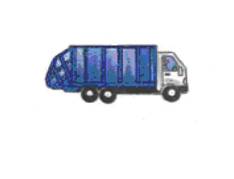
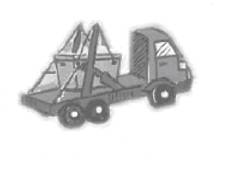
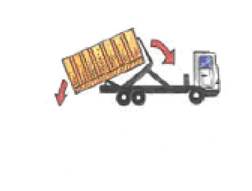
Road is the mode of transport used to dispose of all waste. Areas on the wheely bin system are serviced once per fortnight. The municipality makes use of its own fleet to collect and dispose of general waste. The collection and disposal of the hazardous and medical waste is the responsibility of the province, and this function is outsourced to private companies. The vehicle types within the industry include a variety of various rigid vehicles. See below for the different vehicle types.
Different type of vehicle for collection includes · Tip pak vehicle
· Mobile compactor vehicle
· Skip loader
· Roll-on-roll-off vehicle
· Vehicle with Gatesides or dropsides
| |||||||||||||||||||||||||||||||||||||||||||||||||||||||||||||||||||||||||||