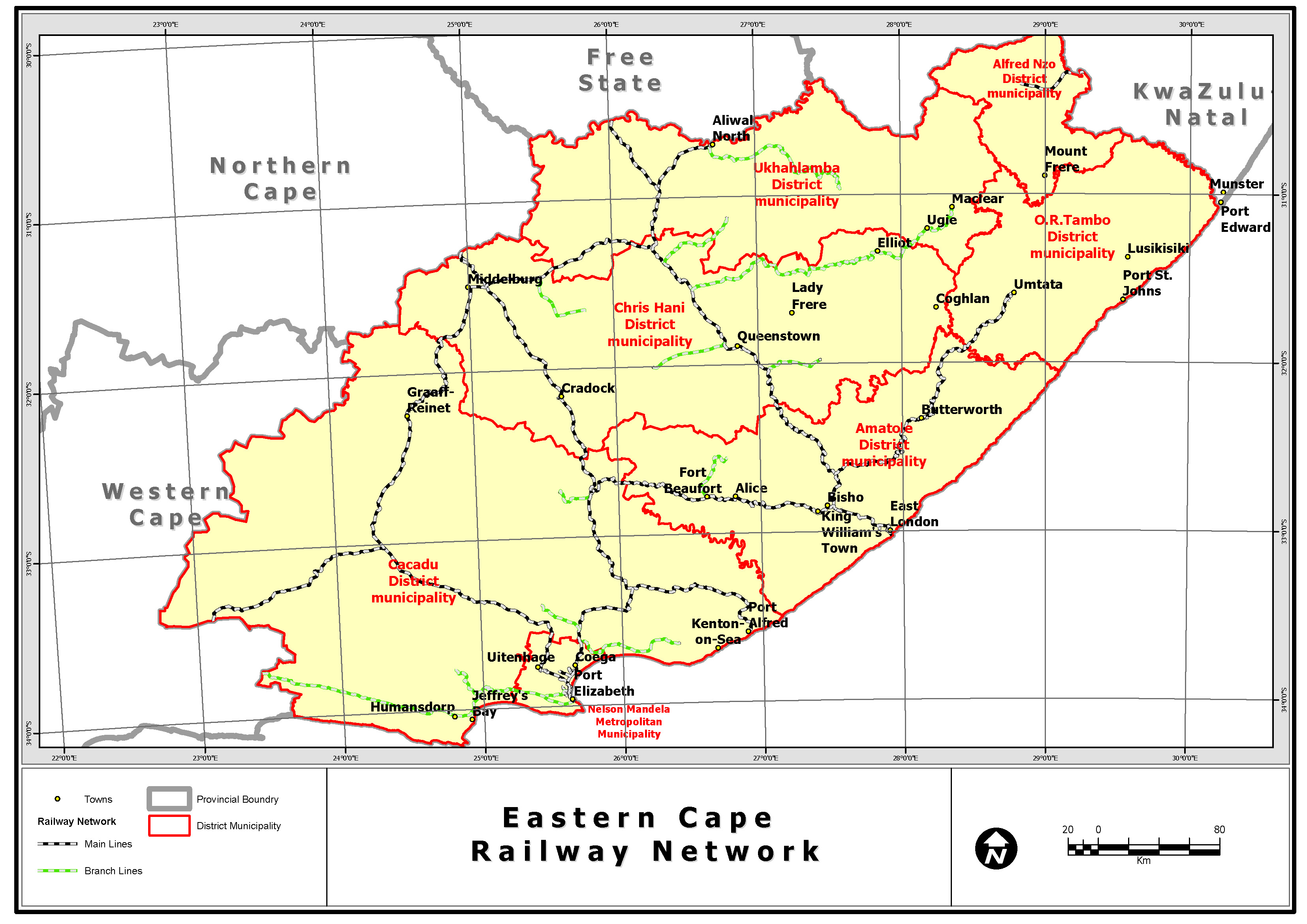
OverviewThe rail freight system of the Eastern Cape is an important element of the South African transportation system and is a significant factor in the movement of freight within the Province and through the Province to destinations in the interior, both within and beyond South African borders.
During the 2005 – 2006 review period, nearly 4 million [metric] tons of cargo was transported by rail across the Eastern Cape over two important mainline arterial routes running from Noupoort to Port Elizabeth and Springfontein to East London. Of the overall total, some 3 million tons consisted of import/export traffic while some 200 000 tons of domestic general traffic was generated and 750 000 tons received at various stations.
There are, in addition, a number of secondary arterial routes, most of which are currently not in operation. This includes the Klipplaat to Graaff Reinet and Rosmead line, as well as the Rosmead – Stormberg line. The Blaney to Cookhouse line is currently in use but at greatly reduced traffic levels. There are also a number of branch lines, some of which a currently not operational, while others have been uplifted.
Portions of the two Eastern Cape main lines run though other provinces. This includes the Port Elizabeth - Noupoort mainline which enters the Northern Cape at Carlton and the East London – Springfontein mainline which enters the Free State at Bethule.
Rail is a significant provider of transportation capacity; however, its market share of general freight traffic has is declined in recent years. This substantial reduction in general freight traffic has also resulted in fewer industrial area shunting activities. This is apparent in the Port Elizabeth and East London in particular. The Province should request that the railway administration investigate the status of all private sidings in the province and not encourage companies to close these facilities until a full appraisal is made about their future value.
In 2006, national government at Cabinet level approved a general policy to encourage greater use of rail transport. This resulted in a complete evaluation of the assets, liabilities and market status of the railway administration. The recently announced R80 billion recapitalisation programme is the first major state initiative to address declining rail cargoes. For the Eastern Cape to ensure maximum benefit from this railway investment programme, joint planning with the administration will be necessary.
An increase in rail market share assumes that the substantial investment planned for rail infrastructure, rolling stock and locos will facilitate a significant improvement in rail service delivery. It must be appreciated that as the railway administration investment programme has barely commenced, there will be some delay before an overall improvement in service delivery is evident. In this respect the administration is likely to follow a targeted marketing approach, concentrating initially on specific commodities or areas. The province needs to ensure that the targeted areas for improved performance are in line with provincial developmental plans.
Picture: Eastern Cape Railway Network
|