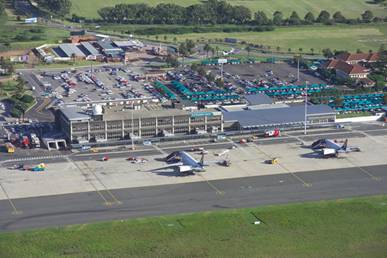
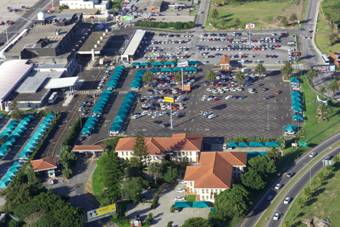
Port Elizabeth Airport
Airport Profile
The Port Elizabeth Airport Profile provides pertinent general information, such as Airport location, ownership, and overall size. The airport is one of 4 airports located in the Eastern Cape Province. The airport is categorised as a Public Airport with World Aviation coding:
IATA: PLZ ICAO: FAPE
The airport’s attributes at a glance are the following: · International License · Proximity to the Port of Port Elizabeth and the Port of Ngqura · Proximity to the IDZ (CDC) · Excellent to Good road and rail network
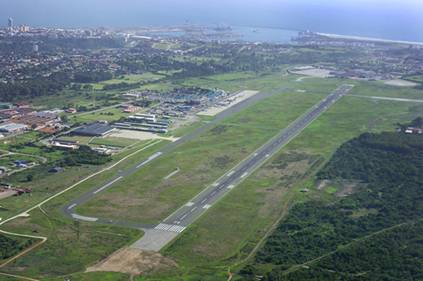
The airport formerly known as H.F. Verwoerd Airport is located in the city of Port Elizabeth, the Nelson Mandela Municipality. It sits approximately 2 miles south of the Central Business District (CBD). Its proximity to the city has given it the name “Ten Minute Airport”.
The geographical location (coordinates) is as follows: Coordinates: 33 degrees 59’ 06” S 25 degrees 37’ 02” E Elevation: AMSL 219 ft/67metres
The airport’s historical development timeline can be described as following: · 1917: Airport first established · 1924: Official opening with a single runway, a hangar · World War II: Airfield extended to accommodate 42 Air School for school for the Royal Air Force and 6 Squadron. SA Air force on Southern and eastern sides of field. Commercial operations conducted from northern side. · 1950: Construction of permanent terminal buildings, runway and air traffic control buildings. Commercial operations moved to an airfield at St. Albans ~ 25 km from the city centre during construction period. · 1954: First jet propelled aircraft (5 De Havilland Vampire FB9’s) lands at airport. · 1955: New building officially opened. · 1973: Apron extended to accommodate larger aircraft. · 1980: New departure terminal opened. These facilities serve airport community until 2000. · 2000: Plans for major terminal upgrade drawn-up. The program included: o Consolidation of arrivals and departures building into a single facility with central retail area linking these areas. o Facilities cater for domestic flights with flexibility to fully operate with compliance to International arrivals and departure protocols. · June 2004: Modern terminal upgrade complete. These upgrades allowed the airport to handle up to 2 million passengers per year.
The airport is owned and operated by the Airports Company South Africa, which also operates 9 other airports in SA. ACSA is solely responsible for approving plans and expenditures for airport facilities. They are also responsible for data to day administration of all activity via the appointed Airport Manager. Management, security and all parking controllers are activities that fall under ACSA Executive staff. SAA and the Equity Aviation supervise baggage ramp and passenger handling.
The airport served approximately 1, 491, 551 passengers in 2007. The airport provides air cargo handling of over 11, 000 tons of cargo in 2006. This figure gives the airport great status in terms of potential and current activity base. Compared to Durban and East London, Port Elizabeth’s cargo operations are worth noting and cultivating. (ELZ handled only 3,420 tons in 2006).
Airport Activity
Air passenger Activity
Passenger activity amounted to 1, 491, 551 enplanements in 2007. These figures are expected to increase drastically due to the 2010 preparations and increased domestics and international tourists.
Air Cargo Activity
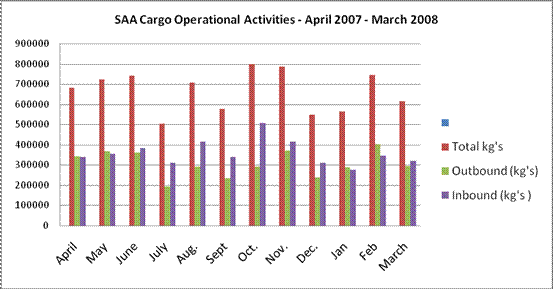
PLZ handles two freighter flights daily and a total of about 830 tons a month. These figures do fluctuate, but the overall tins annually the last two years have averaged over 10,000 tons. There is SAA Cargo, SAFair, Express Air Services, Kulula and Comair (British Airways). All these have a market share handling cargo via aircraft belly-hold. By far the most successful is SAA Cargo.
Based on SARS data in 2006 PLZ exports topped over 2 million kilograms which ranked it in the top four behind OR Tambo, Cape Town and Durban. In fact, the figures with Durban were almost the same. In terms of commodities, SAA cargo Director stated that the top three exports to Europe are: automotive components; fruit and ferns. The latter are exclusively exported to Germany. In addition, they are now exporting platinum which has added to the tonnage for 2007 – 2008.
General Aviation Activity
There are good GA facilities at the airport catering for business jets, private owners, etc. All required support facilities such as hangars, maintenance are available.
Military Activity
No data available at this time.
Airspace and Air Traffic Control
Given the fact that the airport has an international license, all operational requirements (approaches, taxiway and infrastructure are complaint.). The actual data is currently not available, but will be updated in due course.
Airspace ClassificationAirport Facilities
Airport facilities contain the following infrastructure (airside and landside); namely runways, aprons, taxiways, ATC, support facilities, etc.
Airfield Facilities
Runways
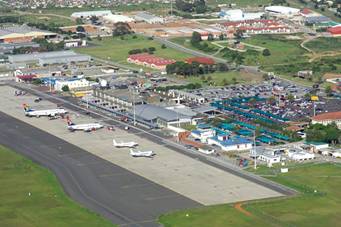
Taxiways and ApronsTaxiways and aprons adequate to accommodate Boeing 737 are available. True measurements will be supplied in due course.
Passenger Terminal Facilities
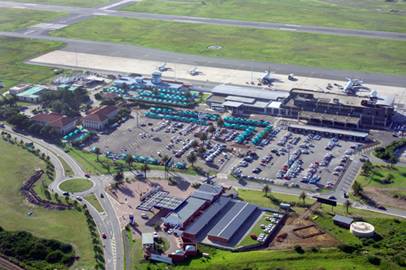
The passenger terminal was upgraded in 2004 and now accommodates several shops, restaurants, coffee shops, Curio shop, ATM facilities and a Conference facility. The terminal can handle up to 2 million passengers a year.
Automobile Parking Facilities
There both short and long term parking facilities for staff and the public at the airport. Parking is located directly adjacent to the terminal in close proximity to Car Rental Facilities. Staff parking, especially ACSA executive is housed in a building next to the passenger terminal.
Linear parking for drop-off and pick-up is accommodated at curb-front.
Rental Car Facilities
Car Rental facilities are in good condition and located opposite the passenger terminal. Current service providers are: Avis, Budget, Euro car, etc.
Air Cargo Facilities
Almost all cargo facilities are located in proximity to the airport, but on private property. Some, like SAA have their own access points to the airside facilities. Some of the operators are: SAA Cargo, Express Air Services via 1 Time; Nationwide handles about 3 tons/month. Total volumes can be attributed to the increased automotive and OEM’s industry share, clothing, textiles, and agriculture products.
Airlines and Airline Support Facilities
The current operators at the airport are the following: · South African Airways -SAA (Johannesburg) · South African Express ( Cape Town and Durban) · Airlink ( Bloemfontein and East London) · 1-Time (Cape Town and Johannesburg) · Kulula ( Cape Town, Durban, Johannesburg and Lanseria)
Support FacilitiesThe airport has a boutique of shops and restaurants, ATMs, telephones and public rest-rooms. There is a coffee shop, bookshop and ground transportation provided by taxis, limo services, etc.
Airport Rescue and Fire Fighting (ARFF)
There is fire fighting (fuselage facilities on site). Actual data on capacity and location is not available, but will be updated in due course.
Fuel Storage and DeliveryFuel farms are located in proximity to the airport. Suppliers are Shell and BP Air.
Airport Maintenance
There is airport maintenance. Data will be updated in due course as it was not available at the time of report writing.
Flight Kitchens
Flight kitchens are adequate and located on –site and in proximity to the airport. Airport Administration
ACSA management have premises at the airport. The Airport Manager is responsible for day to day administration. Currently, the airport is gearing up for executing an Airport Master plan and also preparing for the 2010 FIFA world Cup runway extension of 08/26 from 1, 980 metres to 3, 000 metres.
Ground TransportationGround transportation is provided by taxis, limos and other private tour busses targeting foreign tours.
Roadway and Circulation
The airport is approximately ten-minutes from the CBD. It also links easily to the N2 which extends to Cape Town, Durban, the Port of PE, Port of Ngqura and its CDC. Note: It would be advisable to incorporate internal and external road network analysis in the airport as part of the Airport Masterplan. Areas to cover should be Traffic Characteristics (trip generation & description, Vehicle trips cargo vs. airline passenger, and traffic patterns).
| ||||||||||||||||||