You are here: Home > Industries > Electricity, Gas, Water Supply > Petrolium Refining & Distribution
|
|
Petrolium Refining & Distribution Introduction This industry's value to the SA economy is estimated at about R29.9 billion per year, contributing 3% to the country's GDP. In 2007, 25,8 billion litres of fuel was sold in South Africa, which included petrol, diesel, jet fuel, paraffin, fuel oil, bitumen and LPG. South Africa is dependent on 98% of its oil needs on imports. 75% of the imports are sourced from the Middle East and approximately 23% from Africa. Significantly over the years, more are being imported from Africa.
The petroleum industry in the Eastern Cape is predominantly centred around Port Elizabeth and East London depots, from which the petroleum products are distributed to the various consumers. Distribution into the province is done by road transport and those destined to the Free State and Northern Cape are either done by rail transport.
Volumes – Tonnages
It is estimated that the petroleum sold in the Eastern Cape amounts to approximately 1,8 billion litres.
For the financial year 2007/08, the Port of East London received 70,749 tons of petrol and petroleum gas. For the same year, the Port of Port Elizabeth received 150, 269 tons of petroleum. At this point in time it is unknown as to the amount that is railed to the Free State and the Northern Cape for the 2007/08 financial year. In 2005/06, approximately 47,811 tons was railed from Port Elizabeth to the Free State and 42,081 tons to the Northern Cape. From the Port of East London, 19,051 tons was railed to Upington, 32,906 tons to Lesotho, 9,657 tons to Hamilton in the Free State, 2,911 tons to De Aar and 9,707 tons to Beaconsfield siding in the Northern Cape.
The legislation that is applicable to the petroleum industry includes the following: · Petroleum Products Amendment Act No.2 of 2005 · Petroleum Pipelines Levies Act No.28 of 2004 · Gas Regulator Levies Act No.75 of 2002 · Government Gazette No. 28281 · Petroleum Pipeleines Act No.60 of 2003 · National Energy Regulator Acts 40 of 2004 · National Environmental Management Amendment Act of 2003 · Broad based Black Economic Empowerment Act No.53 of 2003 · National Environmental Managers Act of 98 · White Paper on the Energy Policy of the Republic of South Africa (Dec 98) · Petroleum Products Act. 120 of 1977
Future developments
According to Bloomberg.com, demand for petroleum products in SA jumped by 6 percent in 2007, exceeding local refinery output for the first time. (South Africa's six existing refineries have the capacity to process 708 000 barrels of oil a day.)
PetroSA, plans to build a world-class crude oil refinery at Coega, Port Elizabeth, with the announcement that the company had been granted a manufacturing licence for the project. This licence, is a significant milestone in fast-tracking Project Mthombo, as a strategic initiative to build the 400 000 barrel-a-day crude oil refinery at Coega has been christened. The Controller of Petroleum Products, a unit of the Department of the Minerals and Energy, has approved the granting of a Manufacturing New Licence to PetroSA in terms of The Petroleum Act of 1977. The construction of the refinery is expected to cost US$11 billion and would provide a feasible, sustainable and commercially viable solution to the liquid fuels supply challenges facing South Africa.
The Coega refinery is expected to be the biggest on the African continent. It will come on stream in 2014 and is expected to create over 25 000 direct and indirect jobs around the Port Elizabeth area. The refinery is expected to lower the country's import bill and to significantly reduce South Africa's dependency on imported automotive fuels as demand increases.
The crude oil would be sourced from countries such as Venezuela and Cuba. However, the DME stated that African crude oil producers such the gulf of Guinea, and possibly Angola and Nigeria, would also be approached to supply the refinery. The Coega refinery would be one of the first in the world with the ability to refine sour crude oil, which would make a supply agreement with Venezuela and Cuba practical. The Eastern Cape will to be home to a new 90-million litre bioethanol production plant, The facility, which will cost in the region of R1.3bn and will be located in Cradock in the Eastern Cape and will produce bioethanol from sugar beet.Warding off any criticism of using staple crops to produce bioethanol, sugar beet is a new crop that did not compete with South Africa’s traditional food production. The construction of this large scale 90 million litres bioethanol production facility is expected to start in the second quarter of 2009, this is according to the Central Energy Fund. The Cradock-based plant would produce 90 million litres of bioethanol a year from sugar beet, which is an abundant crop in the Eastern Cape. This will relate to approximately 70 000 tons of bioethanol per year. The project is a joint venture between State-owned financier, the Industrial Development Corporation (IDC), CEF, and Sugar Beet South Africa. Transport trend
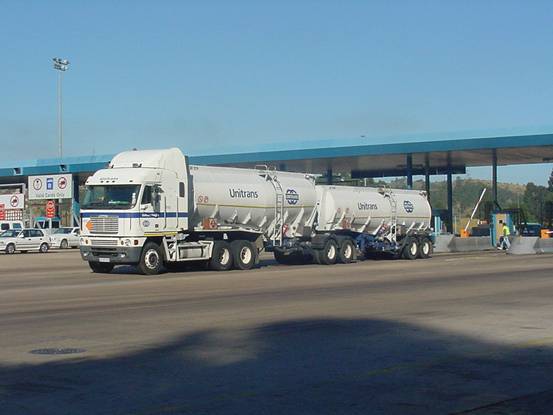
Depending on the availability of ships and products, the petroleum companies combined tend to schedule the product on agreement, to save transport costs. On the ship’s arrival the consignment is then distributed amongst the fuel companies. Depending on the setup of the transport logictics within the company, most of the petroleum companies make use of their own fleet for local deliveries and utilizes road transport contractors for the delivery on the long haul.
Modal Transport Usage:
Road and sea is the mode of transport that is commonly used. The inbound goods are transported by sea and at times by road and the outbound goods are transported by road and rail.
Goods and substances, which are classified as dangerous, need to be identified and in order to do this, the recommendations of the United Nations are used Dangerous goods also need to be packed (where applicable) in a specific package and transported in acceptable packaged goods vehicles or tankers in the case of bulk transportation.
Vehicles transporting dangerous goods in excess of the exempt quantity allowed must be identified by the correct placarding and the trained driver must carry documentation to supplement the information on the placards, to assist the emergency responders in the mitigation of an incident involving the vehicle. Liquid petroleum bulk tankers Gas tankers and all general purpose vehicles carrying petroleum or gas products are required by law to display “Hazchem” labels with details of the products being conveyed.
|