You are here: Home > Industries > Agriculture, Hunting, Forestry & Fishing > Meat & Fish Processing & Distribution
|
||||||||||||||||||||||||||||||||||||||||||||||||
Meat & Fish Processing & Distribution Introduction
The red meat industry remains one of the most important agricultural sub-sectors in South Africa, but has come under increasing pressure in the period following deregulation. This is mainly due to (i) declining per capita demand for red meat, (ii) increased competition from overseas producers, South African Development Community (SADC), Namibia and Botswana, and (iii) institutional challenges. The dwindling per capita demand for red meat can be attributed to several factors. These is a decline in the per capita disposable income of people in South Africa due to poor economic growth, consumers are becoming more health conscious and price competition from other protein sources, most notably poultry. While sheep farming is mainly extensive, a large percentage of beef animals are supplied by feedlots.
The red meat industry in South Africa is characterised by dualism, particularly within the producer sector, with both commercial and developing producers. The commercial red meat industry is extremely efficient and its products compare favourable with the best in the world. Its efficiency is provided by statistics that the country has 1% of the world’s livestock and produces an equal 1% of the world’s red meat. A large genetic pool of stud-stock provides a wide variety of cattle and small stock breeds from which the best adapted commercial herds are bred. (SAMIC, 2004).
Almost 60% of cattle in South Africa are finished for slaughter in sophisticated feedlots (a feedlot is a confined area with watering and feeding facilities where livestock are completely hand fed or mechanically fed to produce consistently quality meat) to produce animals, which are well fleshed, lean and have good conformation. The other 40% of South African cattle is raised on natural pastureland with the final objective of producing healthy and high-grade beef
Following the deregulation of the South African Meat Industry, a number of the larger feedlots have now vertically integrated into processing, wholesaling and even retailing their own quality beef products.
Feedlots
As animals are kept in pens, they do not eat pasture plants like farm animals but are fed grain-based diets, hay or silage. The grain-based diet means this form of livestock production is also called ‘grain fed beef’ production (MLA, 2003a). South African feedlots normally buy, from extensive cattle farmers, weaner calves with live mass of 230 kg at an age of 205 days and add 105 kg carcass mass through extensive feeding of about 100 days, eventually slaughtering an animal at 215 kg carcass mass (SAMIC, 2002c).
The benefits of grain feeding in a feedlot with controlled quality and amounts of food are that cattle produce beef with a uniform carcass fat content and colour. Their food source is not as reliant on the season and it is possible to finish cattle in a feedlot all year round (MLA, 2003a). South Africa has a well-established cattle feedlot sector. Today the South Africa feedlot industry is a flourishing industry that produces approximately 75% of all beef produced in South Africa, which in real terms is in the region of 1,35 million head per annum with a one-time standing capacity of approximately 420 000 head (SAFA, 2003c).
Slaughterings
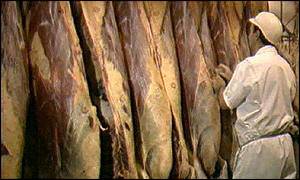
The abattoir industry is responsible for the conversion of livestock to meat. The process remains critical to ensure a safe and wholesome product to consumers. The Meat Safety Act, 2000 (Act 40 of 2000) addresses measures to promote the safety of meat and animal products, and to establish and maintain essential national standards in respect of abattoirs (RMAA, 2002:4).
It is estimated that the total number of cattle slaughtered increased by 12,7 % from 2004/05 to 2005/06 and that the number of sheep (including lambs) and pigs slaughtered increased by 1,4 and 1,0 %, respectively.
In the Eastern Cape, the number of registered abattoirs stands at approximately 83 (see table 1 below) inclusive of 21 abattoirs affiliated to the RMAA, which constitutes approximately 17% of all abattoirs registered in South Africa.
Table 1
The grades of abattoirs varies from an A grade where over 100 cattle are slaughtered a day to grade F, where less that 4 cattle are slaughtered. As South Africa is also a net importer of meat, some of meat originates from Argentina, Brazil, Canada, Australia, New Zealand, etc.
Some of the companies that were researched indicated that they receive their products overseas which included poultry skins and mechanically deboned meat (MDM), which is made up of chicken and turkey. Some of the companies indicated that they receive their products locally within the Eastern Cape in the form of livestock or meat that is already processed as well as game, depending on supply. The companies that own their own abattoirs producers on average 2 000 to 10 000 tons of meat per annum.
Volumes
Imports
Imports of red meat increased from 58 649 tons in 2004/05 to 74 959 tons in 2005/06 (27,8 % higher than the average of approximately 55 787 tons for the fi ve years up to 2005/06). Imports of beef amounted to 24 445 tons, which is 63,0 % higher than the five-year average of 15 000 tons. Imports of pork were 23 787 tons, which is 22,8 % more than the fi ve-year average of 19 364 tons, and imports of mutton amounted to 26 727 tons, which is 24,8 % higher than the average of 21 421 tons for the fi ve years up to 2005/06.
Consumption
Consumption of beef and veal increased by 13,1 %, from 723 000 tons in 2004/05 to 818 000 tons in 2005/06, that of mutton by 4,7 %, from 149 000 tons to 156 000 tons and that of pork by 1,2 %, from 168 000 tons to 170 000 tons.
Transport in the meat industry
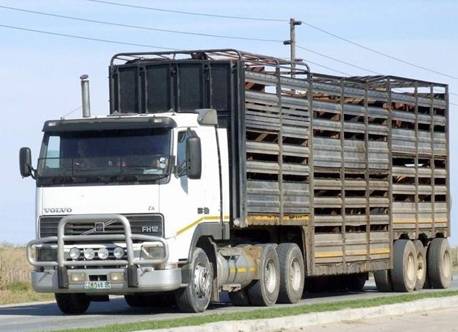
Transport arrangement in the meat industry is entirely by road and sea, using vehicles of appropriate configurations for the cargo carried. With regard to road transport, cattle are transported in open cattle carriers, pigs tend be transported on flat bed gate-sided open vehicles and sheep are transported in purpose-made triple deck livestock carriers. When livestock are ready for the market, the animals are transported from the producer (farmer) or feedlots to the abattoir. Once slaughtered, meat is stored in refrigerated cold stores and the carcasses are transported from the abattoir in refrigerated vehicles for distribution to butchery’s, wholesalers and retailers, and by direct delivery to hotels, restaurants and other hospitality establishments.
Based on the production figures for cattle, an estimated 2,4 million of cattle 5, 2 million sheep and 2 million pigs were transported to various abattoirs in South Africa to be slaughtered which amounts to in excess of 900 000 tons on our road network. Therefore if one includes the imports of beef, mutton and pork, one can then assume that approximately 1 million tons of red meat is being transported to various markets within South Africa.
The supermarkets also play an important role in the distributing of beef products to the countrywide consumer market. Although insulated, these vehicles are not permitted to travel on gravel roads for fear of contaminating the product, which will amount to huge losses.
Meat is also transported in refers (refrigerated containers) by sea for the import and export of meat. Upon reaching its destination, the reefer is loaded onto trucks for its final destrination to the variuos markets.
Statistics
Export Statistics for Beef, Sheep, Pork and offal 2006 Export Statistics for Beef, Sheep, Pork and offal 2007 Import Statistics for Beef, Sheep, Pork and offal 2006 Import Statistics for Beef, Sheep, Pork and offal 2007
|