Main Lines
Main Lines: Inter-provincial arterial
lines
(Connecting the
Eastern Cape with
adjacent provinces)
Port
Elizabeth–
Cookhouse - Noupoort
(and beyond: to De Aar,
Bloemfontein and
Gauteng)
This is the main line route
between Port Elizabeth and
the interior, reaching the important junction of Noupoort, 417
rail kilometres inland. At this point it splits, with one line
running a further 130 km westwards to De Aar on the Western
Cape Mainline and Namibia
route. The other line runs northwards to Bloemfontein and Johannesburg via the Free State mainline, entering that
province at Norvalspont.
The line to Noupoort and De Aar
has generally been referred to as the Cape Midlands Mainline.
It was first opened from Port
Elizabeth to Addo in 1875 and reached Cradock by 1881
and Noupoort by 1883. The link-up with De Aar was completed in
1884 and to Bloemfontein in
1890.
Traditionally, through traffic
between Port Elizabeth and
Gauteng used the
Bloemfontein route. The
distance from Port Elizabeth to Johannesburg is 1 119 km.
Traffic between Port Elizabeth and Johannesburg, can if
required take the Noupoort – De Aar – Kimberley route but this
alternative is 62 km longer than the route via
Bloemfontein.
The section from
Port Elizabeth to De
Aar is electrified at 25kV AC and it is single track
throughout - with the exception of the 11-km section
between Port
Elizabeth and Swartkops, junction of the line to
George. Train operations are controlled by CTC
(Centralised Traffic Control) throughout and the
permissible wagon axle load is 20 tons – standard for all
mainlines. The ruling gradient is 1 in 72 from Port
Elizabeth to Alicedale, 1 in 80 beyond to Noupoort and 1
in 110 to De Aar, while it is 1 in 80 to Bloemfontein.
The line was virtually all rebuilt between 1930 and 1960,
doing away with the steep grades and sharp curves of the
original line. Many of the crossing loops can accommodate
long air-brake export manganese trains operated from the
Northern Province and
plans are being discussed to increase the capacity of the
route.
Photo:
Empty manganese train crossing Fish River at Ripon

Some 2,8-million tons of
through traffic was routed over the line during the Spoornet
2005 – 2006 review period.
This included over 1,9-million
tons of export manganese ore, about 262 000 tons of container
traffic, 158 000 tons of maize and wheat, and over 100 000 tons
of motor cars carried in the special Auto-train. Not all was
long-haul through traffic. 98,819 tons consisted of limestone transported
from Grassridge to New
Brighton, a distance of just 26 kilometres.
When compared to the traffic
levels prevailing during the 1970’s, rail levels have declined
by over 50%. On average between 7 and 8 inland bound trains run
each day, while about 9 run towards the coast. This includes
export maize, manganese and motor vehicle trains. The present
track occupation is between 26% and 35% of theoretical
capacity, depending on the section of line. For this reason,
traffic levels could be doubled without requiring
infrastructural investment.
Photo:
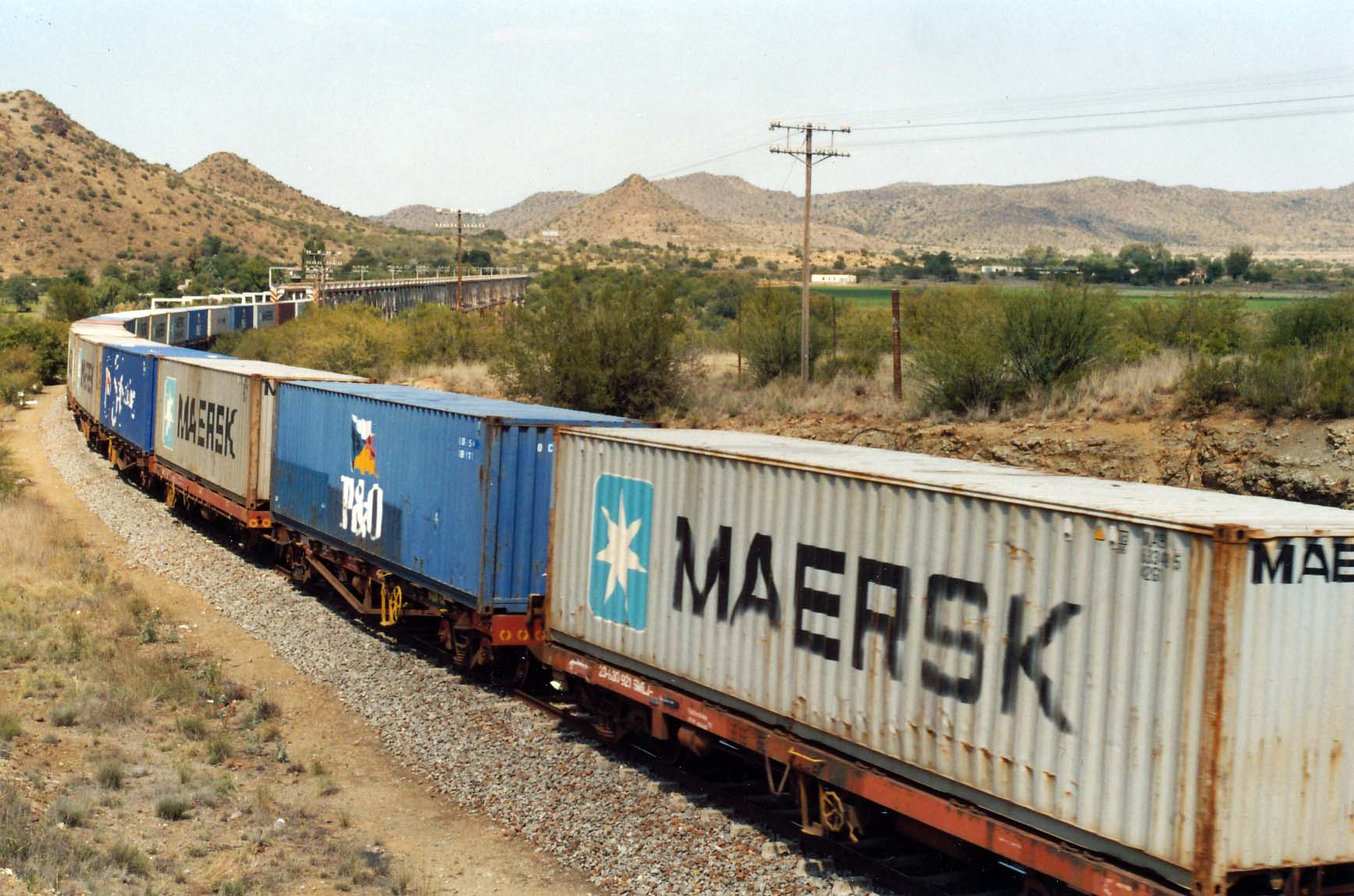
Container train from Port
Elizabeth crossing Gariep
River into the Free State.
East London
– Burgersdorp –
Springfontein
(and beyond to
Bloemfontein and
Gauteng)
This is
generally described as the Cape Eastern Mainline. It runs
472 km inland from East London to Queenstown, Burgersdorp
and Springfontein, where it connects with the Free State
Mainline, running from Noupoort to
Bloemfontein
and
Gauteng. The line was first
opened from East London to
Blaney in 1876. It reached King Williams Town the following
year but the thrust northwards was from Blaney. Queenstown was
reached in 1880, Burgersdorp in 1885 and Springfontein in 1892,
forming a through route to Bloemfontein. Only 433 km of the line
falls within the Eastern
Cape.
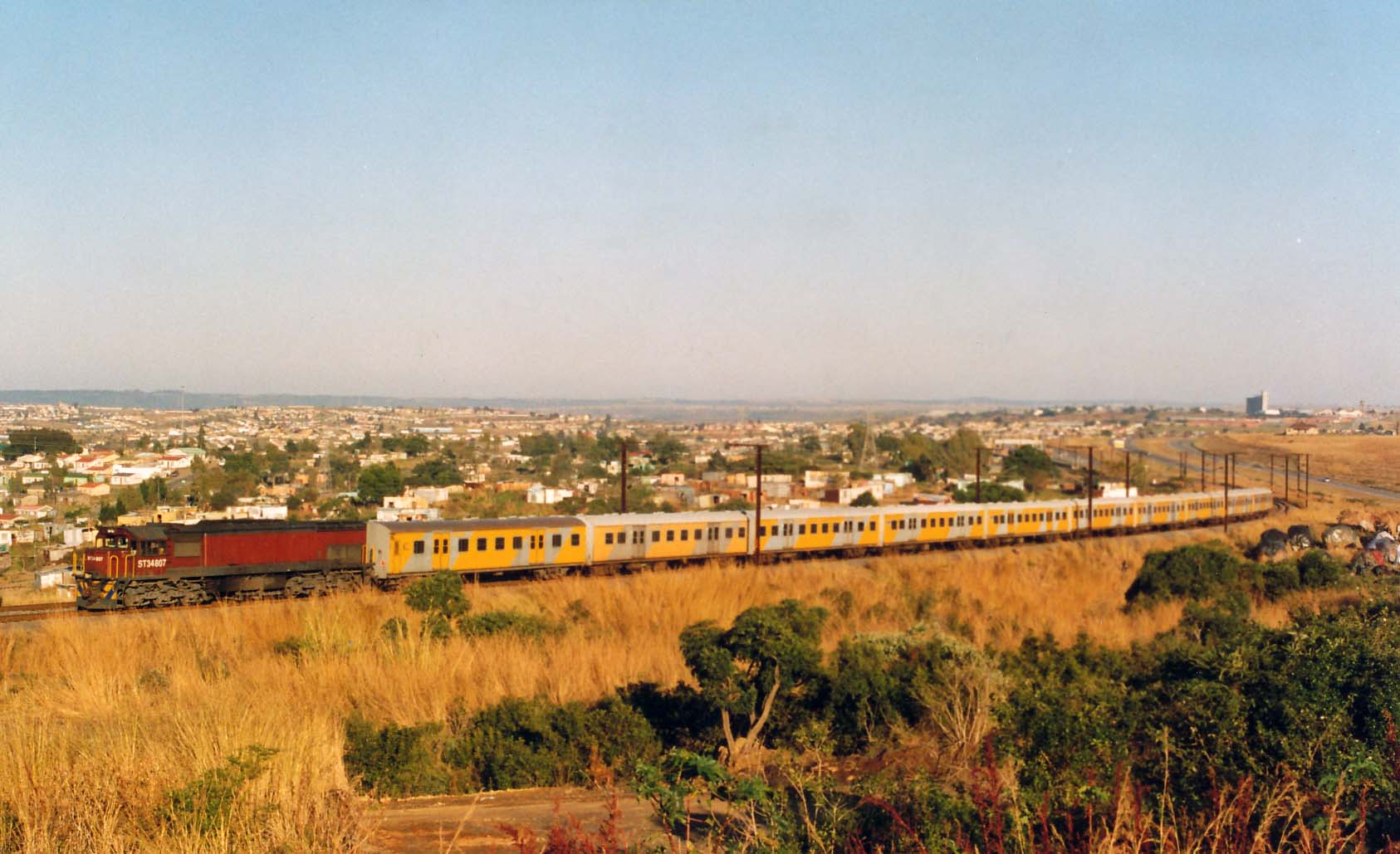
Photo: Suburban
passenger train passing
Mdantsane
The line was
considerably upgraded during the 1940’s and 1950’s, with many
tunnels on the Amabele – Queenstown section. It was later
electrified on the
25 kV AC system
and portions of the line were equipped with the CTC signaling
system, while the remaining portion was equipped with colour
light signaling controlled by local Train Control Officer’s.
The ruling gradient is 1 in 50 Compensated. Like the
Port Elizabeth mainline,
there is a 20 ton permissible wagon axle
load.
As with the Cape
Midlands Mainline, traffic on the East London line has dropped
significantly during the past 20 years. During 2005 – 2006,
about 1-million tons of traffic moved over the line, of which
75 000 was generated and about 780 000 received from other
provinces. About 154 000 was intrastate traffic. Of the
received traffic, 454 805 consisted of maize, of which about
391 000 was exported and the balance to local grain
mills. 244,399
tons of cement was received from the Northern Cape at Queenstown for
general distribution by road.
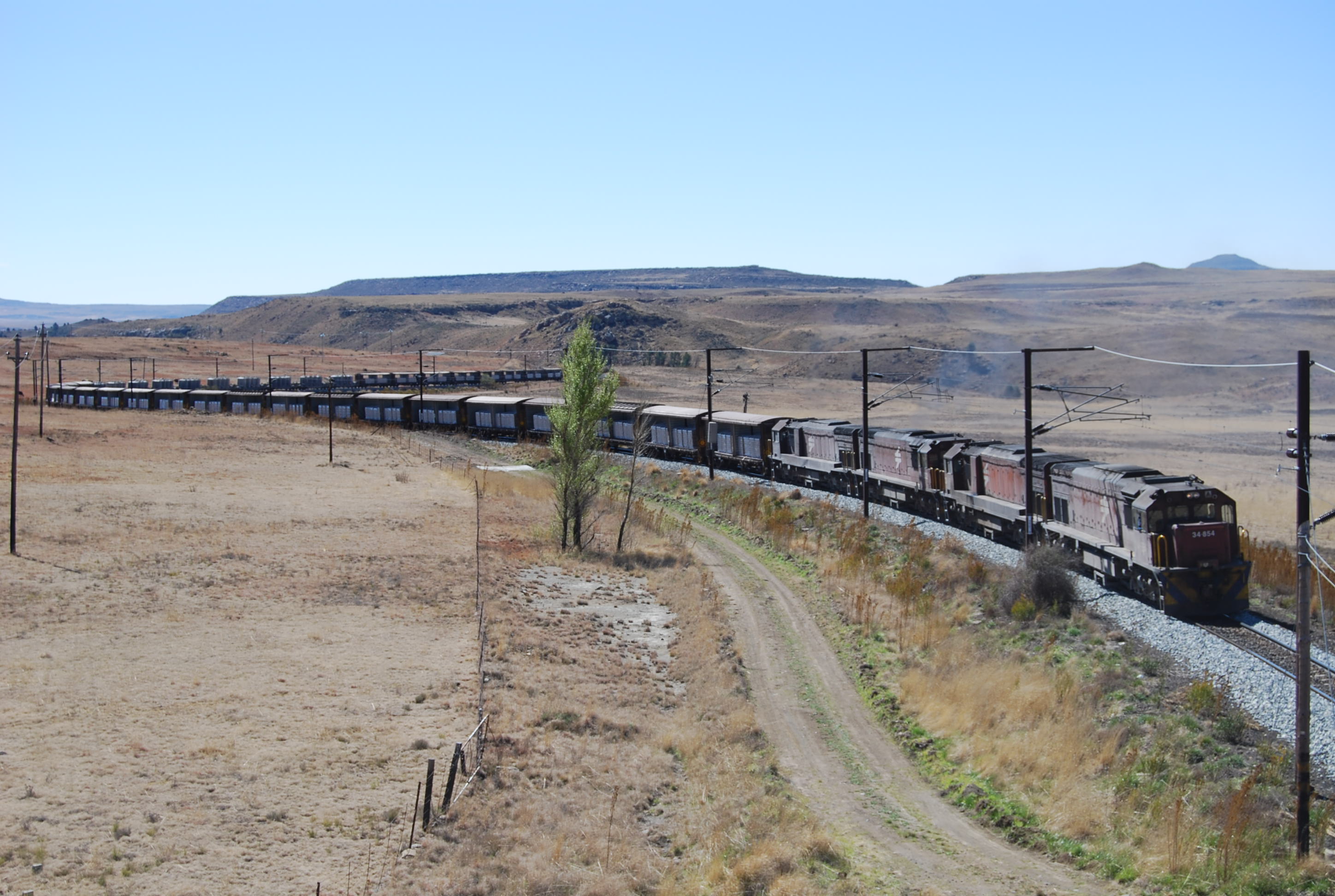
Photo: Loaded
cement train south of
Molteno
At the present
time about three trains to the interior operate every day while
4 run towards the coast. This represents between 30% and 40% of
present line capacity and traffic could double without putting
strain on the infrastructure.
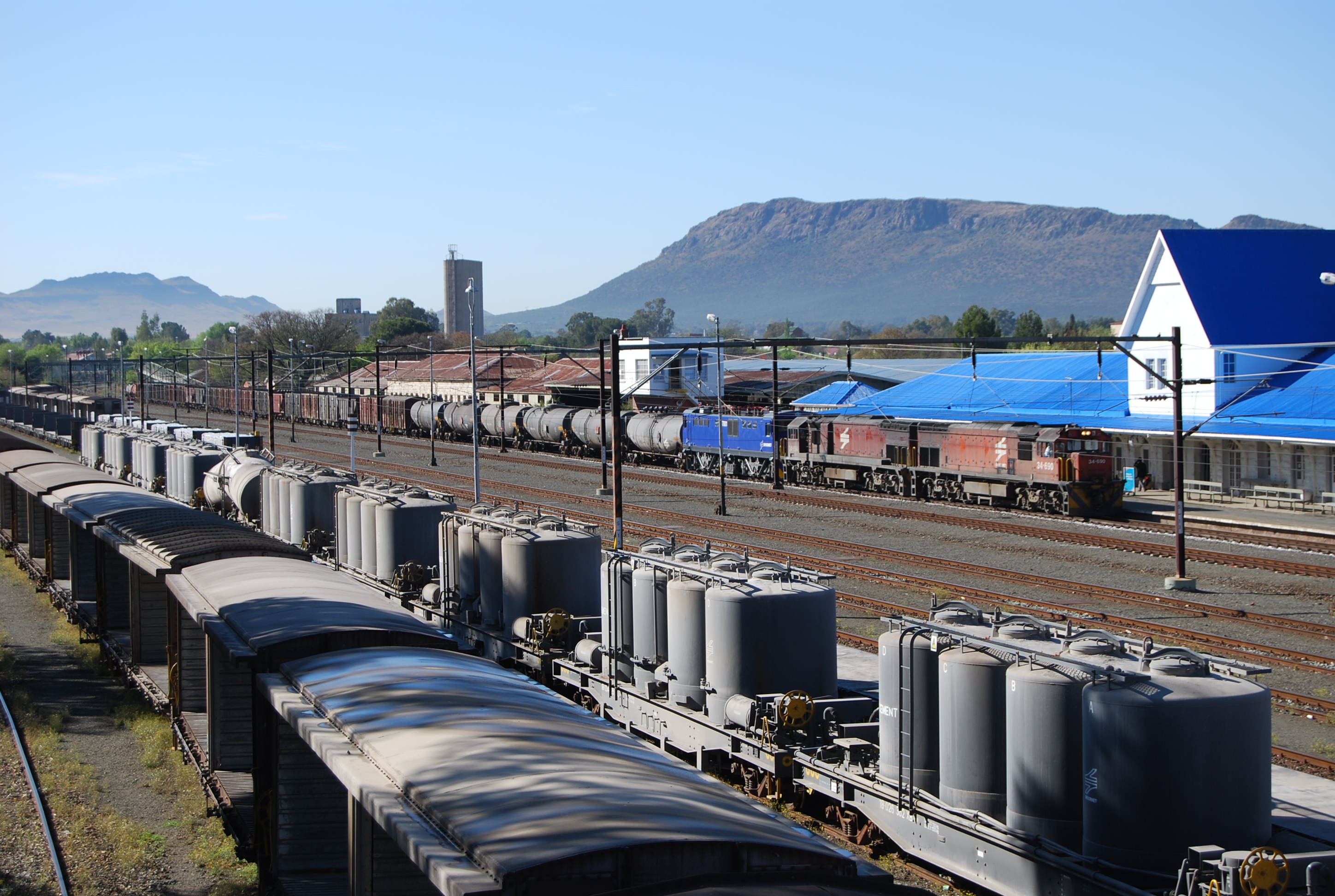
Photo:
Mixed load train at Queenstown station. Wagons for
handling bulk and bagged
cement in foreground.
Swartkops
(Port Elizabeth) –
Klipplaat – Oudtshoorn
(and beyond to George and
Worcester in the Western
Cape)
This is part of the
Garden Route line,
first opened between Swartkops and Uitenhage in 1875 as
the projected railway to Graaff Reinet which was reached
in 1879. This line was later extended northwards to
Middleburg and Rosmead on the Cape Midland Mainline in
1898, forming an alternative route to the original
mainline.
During 1902 a new line was
opened from Klipplaat, south of Graaff Reinet, westwards to
Willowmore. This was extended to Oudtshoorn in 1904 but had to
wait until 1913 for the mountainous line to George to be
completed. As such, it opened an alternative through route from
Port Elizabeth to
Cape Town via
Worcester.
However, the line catered
mainly for local traffic since it was steeply graded in places
and trains could not operate at speeds associated with the main
line via De Aar. After transport deregulation, rail traffic
diminished as the road alternative was freed to compete. Major
flooding in the Little Karoo forced closure of the line
altogether for a period during the 1990’s but it was eventually
re-opened and is operated today by three weekly trains. Because
of the creation of new provincial borders after 1994, this line
runs from the Eastern Cape
into the Western Cape at a
point north of Toorwaterpoort near Barandas, 90 km east of
Oudtshoorn
The line north of Klipplaat to
Graaff Reinet and Rosmead is closed but intact.
The Uitenhage – Klipplaat
section has a ruling gradient of 1 in 35, beyond to Oudtshoorn
it is 1 in 54, and over Montagu Pass to George it is 1 in 31. The
entire line is single track and train control is by Radio Train
Order. On the George – Oudtshoorn section (in the
Western Cape) up to
20 trains could be operated in each direction per day,
while beyond to Klipplaat the theoretical line capacity
is 19 trains in each direction. Towards Uitenhage it is
22 trains in each direction. The distance between
crossing loops is the main reason for this
limitation.
The Swartkops – Uitenhage
section has a 1 in 80 gradient and is controlled by CTC.
(Centralised Traffic Control) Train operations include Metro
suburban services, described elsewhere in this
report.
Photo:
Loading cars into Motor Vehicle train at
Uitenhage
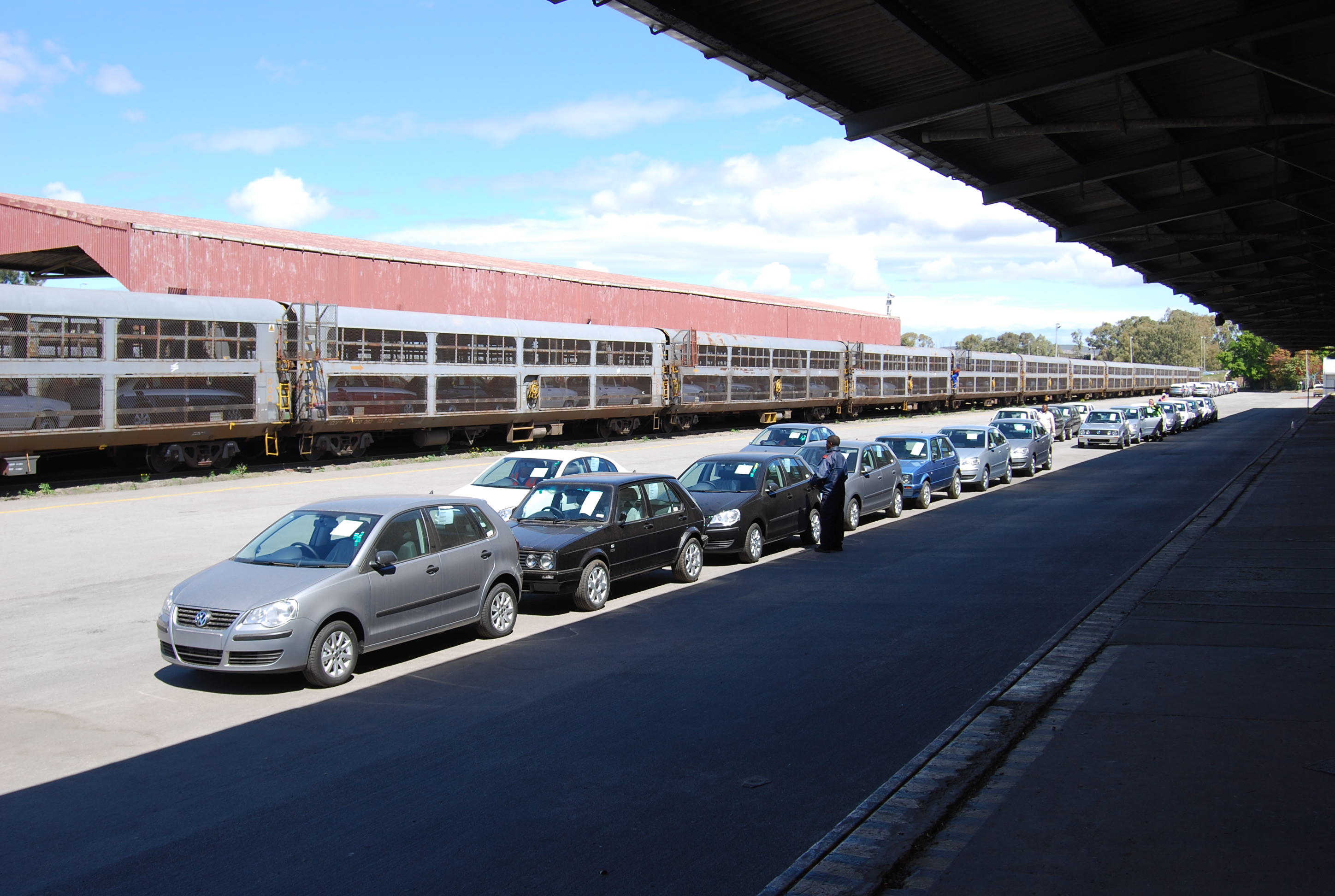
Traffic on the through route is
minimal, the major commodity being gasses from Bartlesfontein
(to the west of Mossel
Bay). During 2005 – 2006,
some 16 000 tons carried in tank cars was transported to
Port Elizabeth and
East London. In addition,
over 5 300 tons of maize was received at Oudtshoon from
Modderrivier, presumably via Port
Elizabeth. A small volume of timber was transported from
Knysna to Richards
Bay, and some timber was
received at Oudtshoorn as well. As late as the year 2000, four
to five goods train were run on the Klipplaat – Oudtshoorn
section each day and over 200 000 tons was moved over the route
annually. This has now dropped to less than 25 000 tons and
without the Graaff Reinet route being re-opened, traffic
between the coast at George and Mossel Bay and the interior is unlikely
to regained to rail.
The national railway
administration investigated the future of this line as part of
the Link Rail initiative in 2005 and proposed setting up an
independently administered railway business unit named the
‘South Cape Railroad.’ It was envisaged that over 650 000 tons
of traffic could be generated and received, of which nearly 60
000 would have been through traffic between Cape Town and Port Elizabeth. Unfortunately there
appears to have been little activity to implement this proposal
and the longer it takes to decide on a way forward, the less
likely that the ambitions of the planners will be
realised.
Klipplaat – Graaff
Reinet – Rosmead (and Noupoort) Secondary Main
line
This line is not currently in
use. It was considered to be an important secondary arterial
line in the past and it even boasted passenger trains Between
Gauteng and Mossel Bay. As
late as the year 2000 the line was served by two goods trains
daily. The main traffic consisted of Mini Containers,
perishable traffic and wool in the Up, or inland direction. In
the opposite direction traffic included general goods, liquids,
cement, containers and domestic coal.
It is ironic, that two
important towns in the area, Graaff Reinet and Middleburg are
now without rail services. The route is single track, with a 1
in 31 ruling gradient over Lootsberg Pass and the maximum permissible wagon
axle load is 18,5 tons, the standard for the Uitenhage –
Worcester route.
Cookhouse – King
Williams Town and Blaney Secondary Mainline
This arterial route, opened in
1904, is the link between Port
Elizabeth and East
London, in addition to serving a number of agricultural
communities en-route. Traffic has declined by over 50% since
the early 1990’s and during the 2005 – 2006 review period, only
about 100 000 tons of traffic flowed over the route. Of all the
communities, only King Williams Town received any traffic. The
main commodity transported was beer, which contributed over 60%
of the total traffic.
62,706 tons of beer from the
Redhouse brewery near Port
Elizabeth was railed to East London via the Cookhouse – Blaney
line.
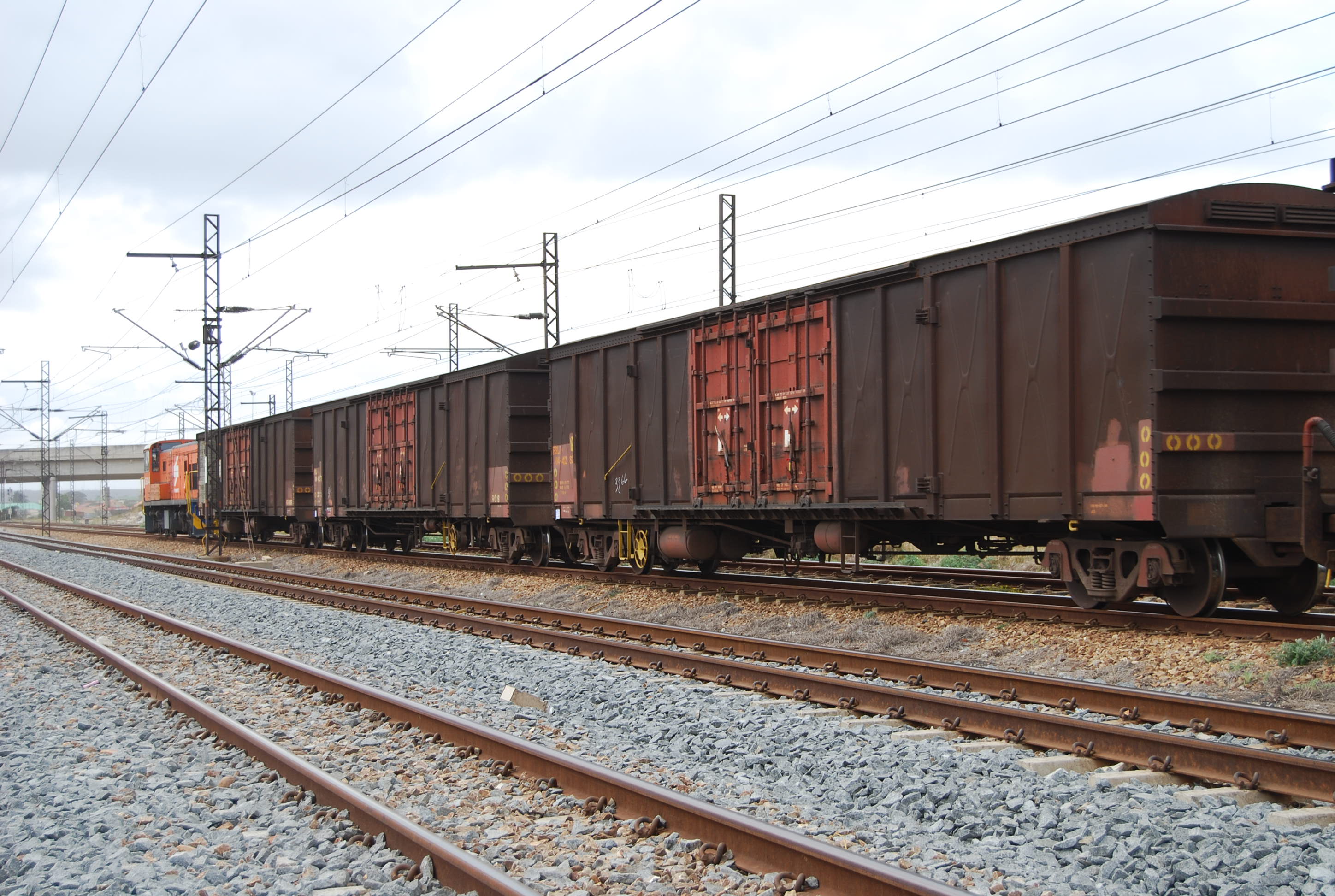
Photo:
Beer train passing Swartkops
During the 1999 – 2000 year,
two daily goods train operated but this has now been reduced to
just one. The ruling gradient is 1 in 34, and the maximum
permissible axle load for goods wagons is 18,5 tons. Train
control is by the Radio Track Warrant system.
For point to point traffic, the
line competes with a much shorter road route and it is unlikely
that much of the traffic which has been lost to road will be
regained without national interventions.
Rosmead – Steynsburg –
Stormberg Secondary Mainline
This once important arterial
line, dating to 1892, has been closed for several years and
part of the line has been uplifted for use on the reconstructed
Belmont – Douglas branch in
the Northern Cape. The 22,5
kg rail track panels from the branch have been brought in to
replace the heavier track which as been taken away but the line
is still broken in places. In the past, the line was used from
passenger and freight traffic between the former
Transkei and the
Western
Cape.
Photo:
Railway line with track panels from Belmont – Douglas branch
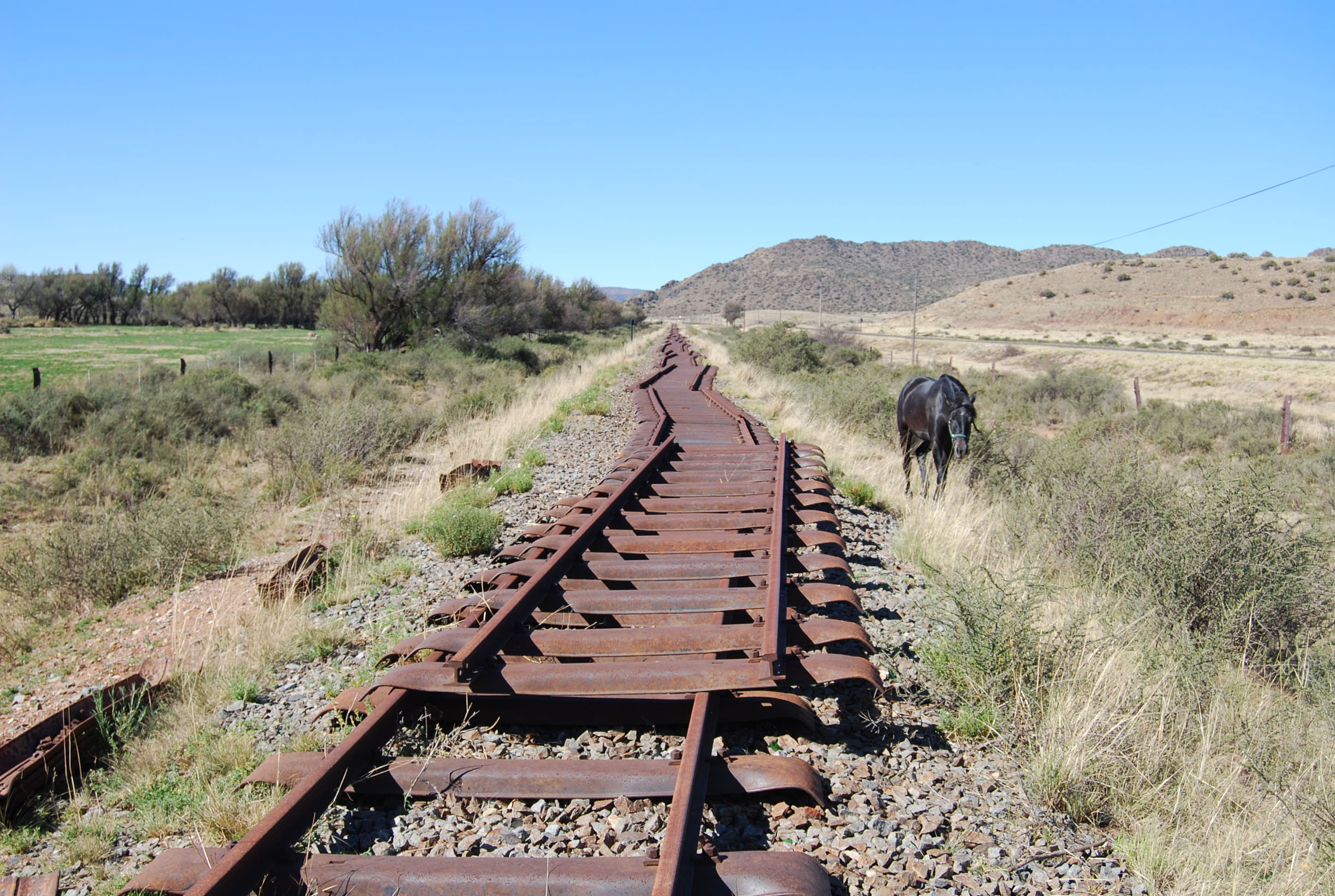
Should it ever become necessary
to use the line again the track panels could only accommodate
an 11,5 ton axle load and would be of little use for mainline
trains. There appears to be little opportunity to generate
local traffic once again and it is unlikely that sufficient
long-haul traffic would make the economically
viable.
Statistics
Port Elizabeth - Noupoort - De Aar Main Line
East London - Springfontein Main Line
Blaney - King Williams Town - Cookhouse Line
Swartkops - Klipplaat - Oudtshoorn (and Western Cape)
Line
| 