You are here: Home > Industries > Agriculture, Hunting, Forestry & Fishing > Fertilizer Production & Distribution
|
||||||||||||||||||||||||||||||||||||||||||||||||||||||||||||||||||||||||||||||||||||||||||||||||||||||||||||||||||||||||||||||||||||||||||||||||
Fertilizer Production & Distribution Introduction Fertilizers can be organic (composed of organic matter), or inorganic (made of simple, inorganic chemicals or minerals). They can be naturally occurring compounds such as peat or mineral deposits, or manufactured through natural processes (such as composting ) or chemical processes (such as the Haber process).
Fertiliser production in South Africa is based on ingredients obtained from various local and overseas sources. The basic ingredients of fertilisers are the elements nitrogen (N), phosphates (P) and potassium (K). For this reason fertiliser values and mixtures are denoted in terms of their NPK composition.
The South African fertiliser industry of today is fully exposed to world market forces and operates in a totally deregulated environment with no import tariffs or government sponsored support measures.
Locality of raw material producers
Primary and intermediate raw materials for the production of fertilizers
Nitrogen
A well reputed company situated on the reef supplies most of the country’s ammonia, with some also coming from Vanderbijlpark Mittal. In South Africa nitrogenous components of mixes and straight fertilisers are in the form of ammonia, and urea compounds are derived mainly from the petrochemical industry in Freestate and Mpumalanga . Due to restructuring at the various plants South Africa now imports all its urea.
Phosphates
An inland based company supplies phosphate concentrates to local and foreign fertiliser producers. Through treatment with sulphuric acid, phosphoric acid or nitric acid, the concentrate is converted into a whole range of intermediate (e.g. phosphoric acid and DAP) and downstream products (e.g. super phosphate).
Potassium
All South Africa’s potassium requirements are imported.
Importance of phosphate rock
Phosphate rock is the primary source of the nutrient phosphorus, an essential element for all life. Phosphate fertilizers stimulate root development, promote flowering and help prevent diseases and environmental stress. Naturally occurring phosphates generally have a low solubility and need to be converted by chemical processing to a form that can be assimilated by plants. Globally more than 90 percent 2 of phosphate rock is used as fertilizers and as an addition to animal feed. Detergent and chemical industries consume the balance.
Rich deposits of phosphorite cover extensive areas of the continental shelf of the west and south coasts of southern Africa. Resources of phosphorite nodules between Cape Town and Port Elizabeth and between Cape Town and Lamberts Bay are estimated at 8000 Mt, grading 10 to 20 percent phosphorus pentoxide.
Local fertiliser consumption in relation to crop production
The South African fertiliser industry annually supplies about 2 million tons of fertiliser products (750 000 tons of N + P 2O 5 + K 2O) to the local market at a value of around R3 billion ($480 million). This represents approximately 20% of the South African chemical industry (excluding oil).
Maize is estimated to be the largest single consumer of fertiliser, with almost 40% of the total fertiliser market, followed by sugar cane (15%) and wheat (10%). The other crops together represent approximately 35% of the total fertiliser market.
Volumes
The highest ever sales of fertiliser in South Africa were recorded in 1981 when a total of 3 290 243 physical tons were sold. This was equivalent to 872 113 tons of plant food, or 26.5% of total physical tons sold. Since then sales have declined and settled at around 2 million tons per annum, but it must be mentioned that the percentage of total plant food has increased from 11.7% in 1955 to last year’s (2007) high of 31.6%.
In 2005 sales fell to their lowest levels in 35 years due to the previous year’s over production of maize. During 2005 the area under maize fell to the figures of 1925. In 2007, the Eastern Cape recorded lime sales of 2698 metric tons.
Source: The fertilizer society of South Africa
South Africa’s current domestic fertiliser demand is around 760 000 tons plant nutrients (N + P2 O 5 + K2 O).
Fertilizers are also produced locally, but the quantity is unknown. Some of the raw products that is used to manufacture the fertilizers such as magnesium nitrate and calcium nitrate, are sourced from the Reef, Cape Town and Port Elizabeth. All products are
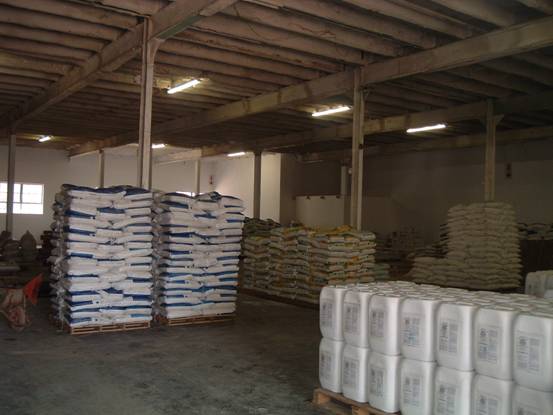
generally sold in 50 kg polypropylene bags, apart from
liquid fertilisers that require delivery tankers, storage
facilities on farms and in-field spray units. Legislate control
All fertilisers, including bagged natural organic fertilisers, must be registered in terms of Fertilizers, Farm Feeds, Agricultural Remedies and Stock Remedies Act 36 of 1947. Registration commits the producer to the specified composition of the fertiliser. The Act is administered by the National Department of Agriculture, and the quality and composition of manufactured products are controlled by the Registrar of Fertilisers. At present there are more than 700 registered products. The fertiliser industry is also subject to factory, labour, transport and environmental legislation.
Transport of Fertilisers
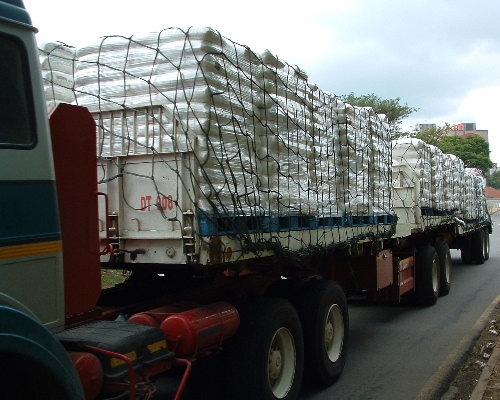
Historically, large volumes of fertiliser were transported by rail by farmers collecting bagged and bulk fertiliser from sidings and transporting these to their farms all over South Africa but there has been a rapid shift over the past several years to road transport, even for long distance deliveries to depots and to the agricultural users of fertilisers. The main reasons for the shift have been the unavailability of rail services, the need to deliver large volumes over short periods during planting seasons and the costs of double handling onto rail wagons and then from rail sidings to farms. Railway data for 2005 confirms that road transport is the mode in current use, The rail data for 2005 indicates that only over 1000 tons of fertilizers was railed from Sasolburg and Danielsrus in the Free State to Paterson (162 tons) and Port Elizabeth (1008 tons). Long distance haulage of fertiliser is done with large interlink combinations carrying maximum payloads of fertiliser, covered with tarpaulins. For shorter hauls a variety of smaller trucks and combinations as well as tractor–trailer units are used.
Click here for statistics for this industry - Fertilizer Consumption by Crop
| ||||||||||||||||||||||||||||||||||||||||||||||||||||||||||||||||||||||||||||||||||||||||||||||||||||||||||||||||||||||||||||||||||||||||||||||||